
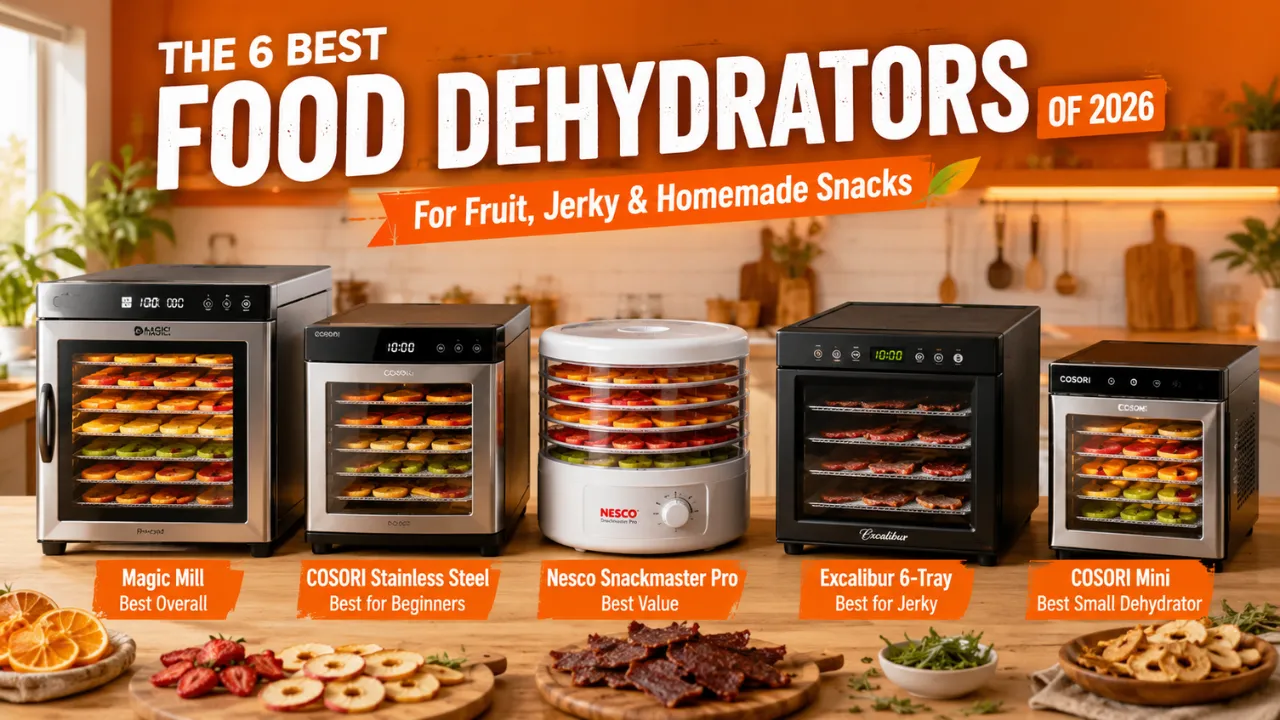
A food dehydrator is perfect for you if you like to make your own snacks, preserve fresh fruits and vegetables or prepare your own beef jerky. You can dehydrate fresh vegetables, fruits, herbs or meat that will be left unused.
The best food dehydrators keep this process straightforward by combining moderate heat with a controlled degree of airflow. Depending on the make, you can dehydrate things like dried fruit, apple chips or vegetable slices or herbs, fruit leather and home made jerky.
Quick Picks: Best Food Dehydrators
| Category | Our Pick | Best For |
|---|---|---|
| Best Overall | Magic Mill Food Dehydrator | Regular home use |
| Best for Beginners | COSORI Stainless Steel Dehydrator | Easy operation |
| Best Value | Nesco Snackmaster Pro | Budget shoppers |
| Best for Jerky | Excalibur 6-Tray Dehydrator | Homemade jerky |
| Best Small Dehydrator | COSORI Mini Food Dehydrator | Small kitchens |
| Best for Families | Nesco Gardenmaster | Large batches |
1. Magic Mill Food Dehydrator – Best Overall
If you are looking for one versatile machine that can prepare different types of food, and do it well — the Magic Mill Food Dehydrator is a tough contender. The multi-tray design provides ample capacity for larger portions, ideal for fruit, veg, herbs and fruit leather or jerky. The airflow design is one of its best perks. A fan on the back pushes warm air throughout the trays, which may encourage more uniform food drying.
Key Features
- Large multi-tray capacity
- Adjustable temperature
- Built-in timer
- Stainless steel trays
- Rear-mounted fan
- Suitable for fruit, vegetables, herbs, and jerky
- Multiple drying settings
Pros
- Excellent for regular dehydrating
- Large capacity
- Good airflow
- Stainless steel construction
- Useful for many different foods
Cons
- Takes more counter space
- May cost more than basic dehydrators
- Larger size can make storage difficult

Also read:Best Dehumidifier for Laundry Room(2026)
2. COSORI Stainless Steel Food Dehydrator – Best for Beginners
For those who are just getting into the game, we recommend the COSORI Stainless Steel Dehydrator. Civlzy retains a simple control panel and a stacked tray system that simplifies the learning process while avoiding complex settings. It is also big enough to accommodate many medium-sized foods for beginners without needing the space of a more commercial style commercial machine.
Key Features
- Stainless steel design
- Multiple drying trays
- Adjustable temperature
- Digital controls
- Timer function
- Compact compared with larger models
Pros
- Beginner-friendly
- Easy to set up
- Good for fruit and vegetables
- Durable construction
- Useful for different recipes
Cons
- Some foods may require experimenting with drying times
- Larger than mini dehydrators

Also read:How to Make Crispy Banana Chips in a Dehydrator: 5 Easy Tips
3. Nesco Snackmaster Pro – Best Value
You may not need an expensive appliance for sporadic dehydrating. The Nesco Snackmaster Pro Food Dehydrator flexes an easier feel and also tends to be a well-liked option for those who want to get their dehydrating experience without breaking the bank. The trays are stackable, letting you add more when you need to store even more. This gives it an added appeal to shoppers who are looking for convenience.
Key Features
- Stackable tray design
- Expandable capacity
- Adjustable temperature
- Compact footprint
- Simple controls
- Good for fruit, vegetables, herbs, and jerky
Pros
- Budget-friendly
- Lightweight
- Easy to store
- Expandable
- Good starter option
Cons
- Fewer advanced features
- Some foods may take longer to dry
- Basic temperature controls

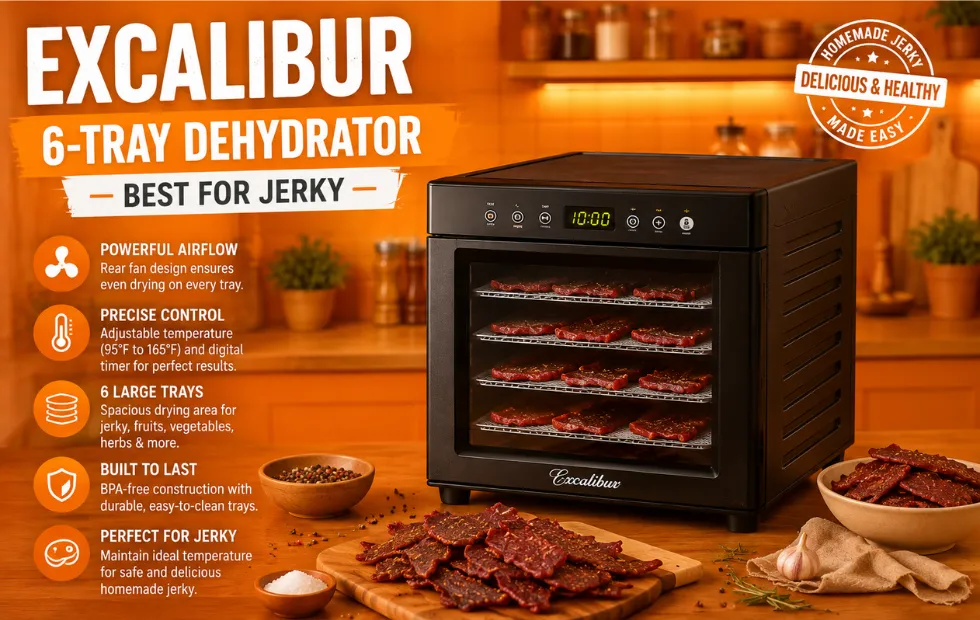
4. Excalibur 6-Tray Dehydrator – Best for Jerky
The Excalibur 6-Tray Dehydrator is worthy of a spot on your shortlist if the only thing you EVER plan to use your dehydrator for is making homemade beef jerky. That large tray provides ample drying space, and adjustable temp and time settings let you tweak the process to fit various recipes. You can, however, use it for fruits, vegetables and herbs – in other words: You are not limited to jerkys alone.
Key Features
- Six large trays
- Digital controls
- Adjustable temperature
- Long timer setting
- Rear airflow
- Large drying surface
Pros
- Excellent for jerky
- Large usable drying area
- Precise controls
- Suitable for different foods
- Easy-to-follow settings
Cons
- Trays may require more cleaning
- Takes up considerable space
- Accessories may be needed for certain recipes
5. COSORI Mini Food Dehydrator – Best Small Food Dehydrator
Short on counter space or cabinets? A small food dehydrator can be better than a full-sized unit. If you have smaller batches, then COSORI Mini Food Dehydrator is the right one for you. With its reduced dimensions, you can stuff it in places like your apartment or a small kitchen, using it for infrequent snack making. Suitable for food (fruit, vegetables, herbs and jerky). Other variations come with attachments for things like fruit leather.
Key Features
- Compact design
- Multiple trays
- Preset programs
- Adjustable temperature and time
- Fruit leather accessories
- Easy storage
Pros
- Saves kitchen space
- Simple controls
- Good for small batches
- Useful for beginners
- Easy to store
Cons
- Limited capacity
- Not ideal for large families
- Multiple batches may be necessary

Final Verdict
The best food dehydrator for you is different from the best one for someone else depends on what you want to make and how often you plan on using it.
A standard home dehydrator with multiple trays will offer useful capacity. A novice may opt for a simple stainless steel machine, but if you are value-minded then a basic stackable dehydrator will do. Homemade jerky is your primary mission, pick one with reliable temperature control and powerful airflow.
All of this can be achieved without turning your entire kitchen into a spice factory.
Prior to purchasing, regarding capacity, temperature range, airflow us tray related next researching with reference we if not facility Sr cleaning and stacking กระเป๋าที่เก็บ src. The proper combination use of characteristics will make your dehydrator more than worth the cost and also can ensure that you enjoy homemade dried foods throughout the entire year.
What Can You Make With a Food Dehydrator?
One of the biggest advantages of owning a dehydrator is its versatility. You can use a food dehydrator machine for much more than beef jerky.
Dried Fruit
Apples, bananas, strawberries, mangoes, pineapple, and other fruits can be turned into convenient homemade snacks.
Vegetables
Dehydrated onions, carrots, tomatoes, peas, and other vegetables can be stored and later added to soups, stews, and other recipes.
Beef Jerky
A good jerky dehydrator can help you make homemade meat snacks. Lean cuts are generally preferred because excess fat does not dehydrate in the same way moisture does.
Herbs
Fresh herbs can be dried and stored for later use. This is particularly useful when you have more herbs than you can use fresh.
Fruit Leather
Fruit purée can be dried into flexible fruit leather, making a homemade alternative to many packaged fruit snacks.
How to Choose the Best Food Dehydrator
Before buying a dehydrator, consider these important factors.
1. Airflow
Good airflow is one of the most important parts of a dehydrator. A fan moves warm air around the food and helps remove moisture.
A crowded tray can restrict airflow, so choose a capacity that matches the amount of food you normally prepare. The competitor’s testing also emphasized airflow and even drying as major factors in dehydrator performance.
2. Temperature Control
Different foods require different temperatures. Look for a machine with adjustable temperature settings instead of a single fixed temperature.
Precise heat control can make the appliance more useful for fruits, vegetables, herbs, and meat.
3. Capacity
Think about how much food you normally prepare.
- Small dehydrator: Good for individuals and small kitchens
- Medium dehydrator: Good for regular family use
- Large dehydrator: Better for gardeners and large batches
A bigger machine is not always better. If you only dry small quantities, a compact model may be easier to store and use.
4. Tray Material
Stainless steel trays are durable and can be a good choice for frequent users. Plastic trays can be lighter and are often found on more affordable models.
Also check whether the trays are dishwasher-safe before purchasing.
5. Timer
A built-in timer is useful because many foods require several hours of drying. You can set the machine and allow it to run without constantly checking the clock.
Some basic dehydrators do not include timers, so this is an important feature to check.
6. Ease of Cleaning
Sticky fruit leather and food particles can make cleanup difficult. Removable trays and dishwasher-safe parts can make the process much easier.
Food Dehydrator vs. Air Fryer
An air fryer and food dehydrator can both circulate hot air, but they are designed for different jobs.
An air fryer generally uses higher heat to cook food quickly, while a dehydrator uses lower, controlled heat over a longer period to remove moisture.
If your main goal is crispy fries and quick meals, an air fryer may be more suitable. If you want dried fruit, herbs, fruit leather, or homemade jerky, a food dehydrator is the more specialized choice.
Are Food Dehydrators Worth It?
A food dehydrator can be worth buying if you regularly make dried fruit, jerky, herbs, or preserved vegetables at home.
It can also help reduce food waste. Instead of throwing away fruit that is getting too ripe, you can slice and dry it for snacks. The competitor source similarly highlights dehydrating as a way to preserve food and make use of produce before it goes to waste.
However, occasional users may not need a large, expensive model. A smaller or budget-friendly dehydrator can be enough for simple projects.
Frequently Asked Questions
Which food dehydrator is best in 2026?
The best food dehydrator depends on your needs. A large multi-tray model is better for families and frequent users, while a compact dehydrator is more practical for small kitchens. For beginners, look for simple controls, adjustable temperature, and easy-to-clean trays.
What is the best food dehydrator machine?
The best machine should provide consistent airflow, adjustable temperature, suitable capacity, and convenient controls. For frequent use, stainless steel trays and a timer can also be valuable features.
What is better than a food dehydrator?
There isn’t one appliance that is better for every situation. An air fryer is better for fast cooking and crisping, while an oven can handle larger cooking tasks. A dedicated dehydrator is usually the better choice when your goal is to remove moisture from food over several hours.
What is the best dehydrator for fruit?
For fruit, look for a dehydrator with consistent airflow, adjustable temperature, and enough tray space for the amount of fruit you want to prepare. A compact model can work well for occasional snacks, while larger machines are better for big batches.
What is the best dehydrator for jerky?
The best dehydrator for jerky should offer reliable temperature control, good airflow, and enough tray space. Models with rear-mounted fans and adjustable settings can be particularly useful for achieving consistent drying.
How long does food take to dehydrate?
Drying time depends on the food, thickness, moisture content, temperature, and dehydrator. Thin apple slices may dry much faster than thicker or wetter foods. Always follow a reliable recipe or food-safety guidance for the specific food you are preparing.





1 Comment
[…] Also read:The 6 Best Food Dehydrators of 2026 […]