
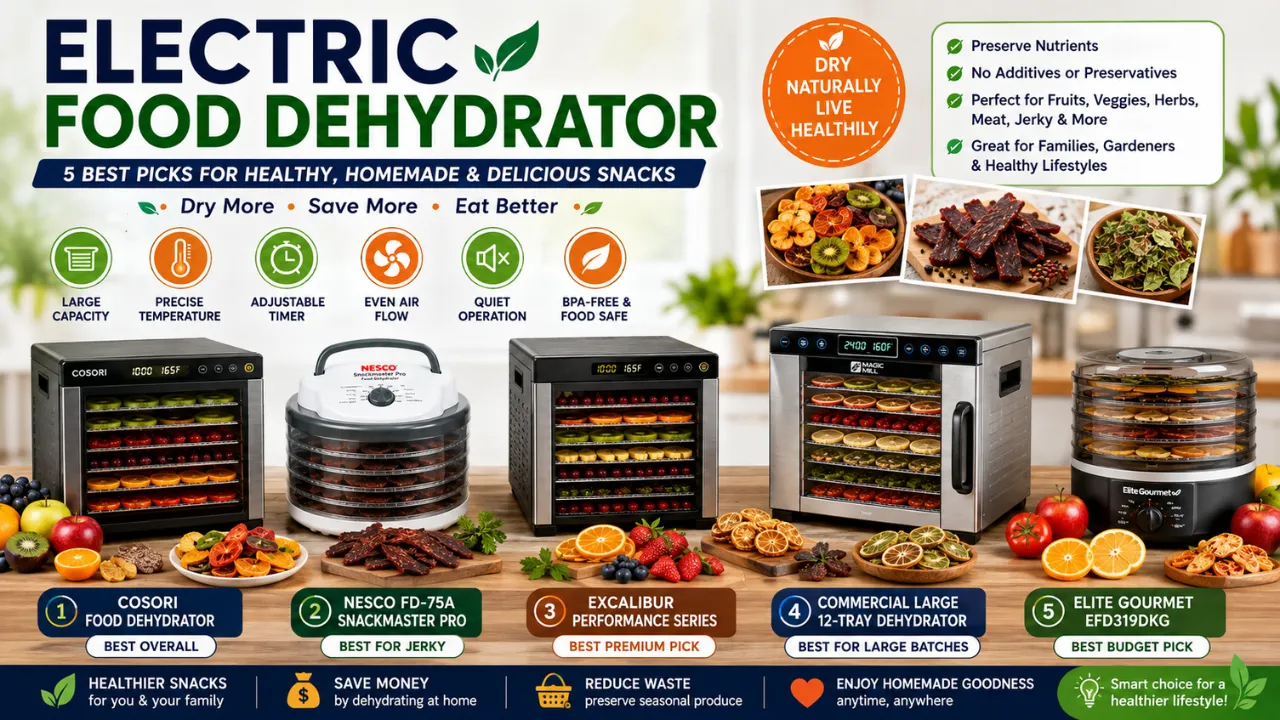
The Electric food dehydrator is one of the most useful kitchen appliances if you want to dry fruits, vegetables, herbs, meat, and other suitable foods. You can make a lot of foods at home and also control the contents rather than buying packaged dried snacks. There are so many of food dehydrators come out there, which makes your choice hard one. Some of them are made specifically for regular home use, while others provide large capacity models suitable for families or gardeners or those who want to dehydrate food in bulk.
Electric Food Dehydrator Comparison
| Product | Tray Capacity | Power | Temperature Range | Timer | Best For |
|---|---|---|---|---|---|
| COSORI Food Dehydrator | 6 trays | 600W | 95°F–165°F | Up to 48 hours | Overall home use |
| NESCO FD-75A | 5–12 trays | 600W | 95°F–160°F | Not specified in supplied details | Jerky |
| Excalibur Performance Series | 10 trays | Not specified | 85°F–165°F | Up to 80 hours | Premium use |
| Commercial Large Dehydrator | 12 trays | 1200W | 70°F–190°F | 30 min–24 hours | Large batches |
| Elite Gourmet EFD319DKG | 5 trays | 350W | 95°F–158°F | Not specified | Budget home use |
1. COSORI Food Dehydrator – Best Overall
The COSORI Food Dehydrator with 6 stainless steel trays is a powerful contender in the capacity, control, and ease of use departments. Offering 6.5 square feet of drying space, it will give the user plenty of room for larger batches. Electric Food Dehydrator The 600W motor pairs with a rear fan and airflow system to dry food faster and more evenly without the need for users to manually rotate trays. It features a temperature up to 165 and timer can go right upto 48 hours.
Pros
- Six stainless steel trays
- 6.5 ft² drying space
- Powerful 600W motor
- Rear-mounted fan
- Adjustable temperature from 95°F to 165°F
- Timer up to 48 hours
- Quiet operation
- Dishwasher-safe trays
- Includes mesh screen and fruit roll sheet
- Recipe cookbook included
Cons
- Larger than compact dehydrators
- 600W power may consume more electricity than smaller models
- May be more capacity than occasional users need
- Requires adequate storage space

Also read : Best Dehumidifier for Grow Tent (2026)
2. NESCO FD-75A Snackmaster Pro – Best for Jerky
The NESCO FD-75A Snackmaster Pro is perfect for snacks, dried fruit, vegetables — and most importantly jerky. This model has a 600 watts drying system with Converga-Flow airflow technology which combines the heated air and fans to ensure the heat rises without needing to rotate the trays Electric Food Dehydrator. A significant merit of it is its expandable space. The machine comes with five trays but can be expanded to 12, allowing users to make bigger batches when necessary.
Pros
- 600W drying system
- Converga-Flow airflow
- Expandable from 5 to 12 trays
- Adjustable 95°F–160°F temperature
- Top-mounted fan
- Suitable for jerky, fruit, vegetables, and herbs
- Includes fruit roll sheets
- Includes Clean-A-Screens
- Jerky seasoning sample included
- Made and assembled in the USA according to the supplied product information
Cons
- Basic design compared with some digital dehydrators
- Initial five-tray capacity is smaller than some large models
- Additional trays may be needed for maximum capacity
- Temperature control uses a dial rather than a digital display

3. Excalibur Electric Food Dehydrator – Best Premium Pick
You Will Love itIf you are looking for a high-end dehydrating appliance with plenty of drying space, the Excalibur Electric Food Dehydrator Performance Series is perfect. Its dehydrator at this stage consists of 10 stainless steel trays, which allows for an estimated 16 square-feet of drying area. Electric Food DehydratorThis makes it perfect for anyone who wants to dry more than one food type at once, or someone who is preparing bulk batches.
Pros
- 10 stainless steel trays
- Approximately 16 ft² of drying space
- Horizontal airflow
- Designed for even drying
- Adjustable 85°F–165°F temperature range
- Up to 80-hour drying timer
- LED control panel
- Glass door
- Large capacity
- Suitable for preservation and large batches
Cons
- Large footprint
- May be more expensive than basic dehydrators
- Large capacity may not be necessary for occasional users
- Requires more storage space

4. Commercial Large 12-Tray Food Dehydrator – Best for Large Batches
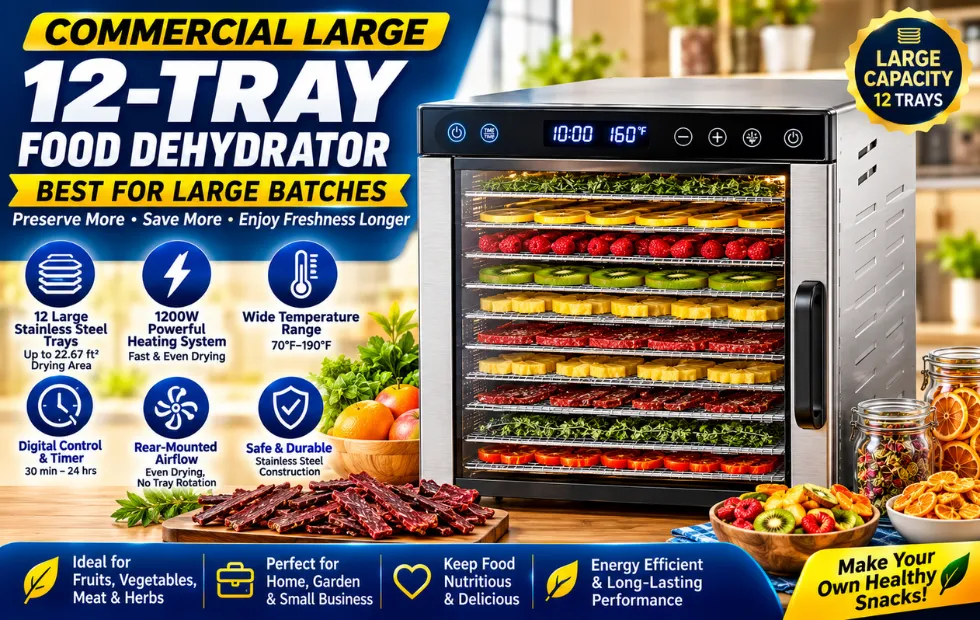
Commercial Options If you are mainly concerned about capacity there is plenty of drying space offered with the Commercial Large 12-Tray Food Dehydrator. According to the provided product information, this is a commercial-design machine with 12 stainless steel trays which have usable Electric Food Dehydrator areas of up to 22.67 square feet. Our electric food dehydrator has a 1200W heating system and adjustable temperature from 70°F to 190°F, with a digital control panel for setting timer from 30 minutes to 24 hours in increments of 30 minutes.
Pros
- 12 large drying trays
- Up to 22.67 ft² usable area
- 1200W power
- Wide 70°F–190°F temperature range
- Digital controls
- 30-minute to 24-hour timer
- Stainless steel construction
- Glass front door
- Rear-mounted fan
- Overheat protection
- Automatic shutdown function
- Includes useful accessories
Cons
- 1200W power can use more electricity
- Large size requires significant space
- More suitable for large batches than occasional use
- Product information states it is designed for 120V/60Hz and is applicable to the USA and Canada
5. Elite Gourmet EFD319DKG – Best Budget-Friendly Pick
Elite Gourmet EFD319DKG Food Dehydrator For people that are looking for a more simple electric food dehydrator for everyday use at home. It comes with five 11.4 inch trays made out of BPA free plastic, using a 350W heating system. Electric Food DehydratorThe ideal temperature dial is adjustable for food like fruits, vegetables, herbs, mushrooms in the range that goes as low as 95 °F and high of 158 °F enough.
Pros
- Five BPA-free trays
- 350W heating system
- Adjustable 95°F–158°F temperature
- Transparent trays
- Bottom-mounted fan
- Suitable for fruits, vegetables, herbs, mushrooms, and jerky
- Dishwasher-safe removable parts
- Compact home-friendly design
- Lower power than larger 600W and 1200W models
Cons
- Smaller capacity than 10- and 12-tray models
- No large digital display
- Temperature range is narrower than some competitors
- May not be ideal for very large batches

Final Verdict
However, an electric food dehydrator is very handy if you’re a fan of homemade dried snacks and want to preserve food. The choice of your model, which depends on the area and budgetary inconvenience Electric Food Dehydrator, suitable capacity size if one wants to make cakes with beef or chicken. To sum up, the COSORI 6-tray dehydrator is a good all-around option for general home use, and the NESCO FD-75A Snackmaster Pro continues to hold very strong appeal as a dehydrator particularly suitable for jerky fans. For larger drying capacity and advanced features, Electric Food Dehydrator then the Excalibur Performance Series is a more appropriate option. For example, the 12-tray commercial model targets extremely large batches and the Elite Gourmet EFD319DKG is an entry-level dehydrator designed for beginners and budget users.
Before buying an electric food dehydrator, consider these important features.
1. Tray Capacity
The number of trays determines how much food you can dry at once. Five trays can be enough for occasional home use, while 10 or 12 trays are better for large batches.
2. Temperature Control
Adjustable temperature is important because fruits, vegetables, herbs, and meat may require different drying conditions. Electric Food Dehydrator A wider temperature range can provide greater flexibility.
3. Airflow System
Good airflow helps distribute heat throughout the dehydrator. Electric Food Dehydrator Rear-mounted and horizontal airflow systems can help produce more consistent drying.
4. Timer
A long timer is useful because some foods take many hours to dry. The Excalibur, for example, offers up to 80 hours of timer operation based on the supplied product information.
5. Tray Material
Stainless steel trays are attractive to users looking for durable construction. Electric Food DehydratorBPA-free trays can also be a consideration when selecting a home food dehydrator.
6. Cleaning
Look for removable or dishwasher-safe trays if you want easier cleanup. This can be especially useful when making sticky foods such as fruit leather.
Do Food Dehydrators Use a Lot of Electricity?
Do food dehydrators use a lot of electricity? It depends on the dehydrator’s wattage and how long you operate it.
The products in this comparison range from 350W to 1200W. A 350W dehydrator generally has a lower rated power draw than a 1200W model, but the total electricity used also depends on the drying time.
You can estimate energy consumption with this simple formula:
Electricity used = Power in kW × operating hours
For example, a 600W appliance running for 5 hours uses approximately 3 kWh under continuous full-power operation. Actual consumption can vary because heating elements may cycle during operation.
What Is the Price of a Food Dehydrator Machine in Pakistan?
What is the price of a food dehydrator machine in Pakistan? The price can vary depending on the brand, capacity, features, seller, import costs, and exchange rate.
Imported Amazon models may have a different final cost in Pakistan because shipping, taxes, customs, and seller charges can affect the total price.
For this reason, it is best to check the current selling price before purchasing. Instead of choosing only by price, compare capacity, power, temperature control, tray material, and warranty or seller support.
Are Food Dehydrators Worth Buying?
Are food dehydrators worth buying? They can be worth buying if you frequently make dried snacks or preserve food at home.
A dehydrator can be especially useful if you have a garden, regularly purchase fresh produce, make jerky, or prefer homemade snacks. It can also give you more control over ingredients.
However, if you only plan to dehydrate food once or twice a year, a large machine may not be necessary.
What Is the Best Dehydrator to Buy for Home Use?
What is the best dehydrator to buy for home use? There is no single best model for everyone.
For general home use, the COSORI 6-tray model offers a useful combination of drying space, 600W power, stainless steel trays, digital temperature control, and a long timer.
For jerky, the NESCO FD-75A Snackmaster Pro is an attractive option because of its airflow system, adjustable temperature, and expandable tray capacity.
For premium large-capacity use, the Excalibur 10-tray model provides 16 square feet of drying space and an extended timer.
For a simpler budget choice, the Elite Gourmet EFD319DKG offers five trays and a 350W heating system.
What Are the Disadvantages of a Dehydrator?
What are the disadvantages of a dehydrator? The main disadvantages are long drying times, electricity use, storage space, and the need to prepare food correctly.
Large food dehydrators can also take up significant counter space. Some foods may require many hours to dry, so dehydration is not always a quick cooking method.
Another consideration is that drying reduces the size and weight of food, which can make it easy to eat more of a dried food than you might eat in its fresh form.
Can Bacteria Grow in a Dehydrator?
Can bacteria grow in a dehydrator? Yes, bacteria can survive or grow if food is handled, prepared, or dried incorrectly. A food dehydrator should not be treated as a guarantee that harmful microorganisms will be eliminated.
This is particularly important when preparing meat or jerky. Use a tested food-preservation method and follow the manufacturer’s instructions and appropriate food-safety guidance. Keep raw foods separate from ready-to-eat foods, clean equipment properly, and store finished dehydrated foods appropriately.
Frequently Asked Questions
What can you make with an electric food dehydrator?
You can make dried fruits, vegetables, herbs, mushrooms, fruit leather, jerky, and other suitable dried foods. Some dehydrators can also be used for appropriate pet treats and food-preservation projects.
How long does food take to dehydrate?
Drying time depends on the food, slice thickness, moisture content, temperature, and dehydrator design. Some foods may take several hours, while others require longer.
Is a stainless steel food dehydrator better?
Stainless steel can be appealing because of its durability and food-preparation design. However, the overall airflow system, temperature control, capacity, and ease of cleaning are also important.
Can I make jerky in an electric food dehydrator?
Yes, several models in this article are designed for jerky. The NESCO FD-75A, for example, specifically supports jerky preparation and includes a jerky seasoning sample according to the supplied product information.
Is a 5-tray dehydrator enough for a family?
A five-tray model can be enough for smaller batches and regular home use. Families that want to dry large quantities at once may prefer a 10- or 12-tray machine.
What Is an Electric Food Dehydrator?
An electric food dehydrator is a kitchen appliance that uses controlled heat and airflow to remove moisture from food. It usually contains several trays where food is placed in a single layer.
Depending on the model, you can adjust the temperature and drying time. This makes a food dehydrator useful for preparing dried fruit, vegetables, herbs, jerky, fruit leather, and other suitable foods.
Compared with traditional air-drying methods, an electric dehydrator provides a more controlled environment. Models with horizontal or specialized airflow systems can also help distribute warm air more evenly.
Why Use an Electric Food Dehydrator?
A food dehydrator can be useful if you regularly buy fresh produce or enjoy making homemade snacks. Drying food can make it easier to store and carry while creating different textures and flavors.
Common uses include:
- Drying apples, bananas, oranges, and other fruits
- Making vegetable snacks
- Preparing jerky
- Drying herbs and mushrooms
- Making fruit leather
- Preparing suitable pet treats
- Preserving seasonal produce
- Creating homemade trail snacks
- Drying ingredients for recipes
The best food dehydrator for you depends on how often you use it, how much food you want to dry at one time, and how much counter or storage space you have.